A Winter Walk Through a Market Square
Take a winter walk through a market square and notice where shelter, entrances and trading routines shape a route, without mistaking one visit for the norm.
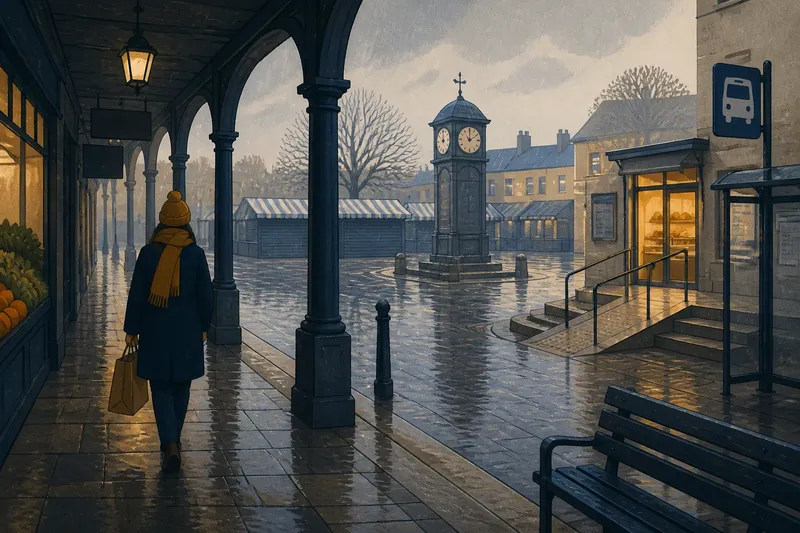
A winter walk through a market square can start beside a locked stall, with rain darkening the paving and a bakery door glowing across the open space. Rather than making a record of every passer-by, choose one practical question: how does the square help someone get from its edge to somewhere warm, covered or useful?
What route can you follow without getting in the way?
Pick a public path from a clear starting point, such as a clock, bus stop or market gate. Walk it at an ordinary pace. Keep clear of doorways, queues and stallholders, and leave your phone in your pocket unless you need it for a brief note.
Let the route tell you what to notice. Does it run beneath an arcade, cross exposed paving or pass a shop that is still open? A winter square is not a fixed scene: trading hours, weather and the day’s errands affect what is available. Record those conditions before drawing a broader conclusion.
Where can a person pause or get out of the weather?
Look for usable cover rather than simply naming architectural features. An awning may shelter the doorway but not the pavement beyond it; an arcade may offer a continuous path, or stop abruptly at an open corner. Notice how the route changes at each point.
Benches, a covered noticeboard and a recessed entrance serve different purposes. A bench may be exposed to wind, while a doorway might provide cover but not be a place to linger. Describe what the feature physically offers, and avoid assuming why someone chooses to stop there.
Imagine you arrive carrying a paper shopping bag in steady drizzle. You start at the bus stop, walk along an arcade to a greengrocer, then cross the open centre towards a covered passage. At each turn, you note whether the route stays dry and where the paving becomes exposed. Your resulting account describes one possible journey through the square; it does not claim that every visitor takes it.
How do entrances and surfaces change the route?
Thresholds can alter a walk without looking dramatic. A change from rough paving to smooth stone may mark a shop entrance. Bollards can separate a pedestrian route from vehicle access, while a ramp beside steps offers another way into a building. Describe the visible arrangement rather than guessing who uses it.
Notice whether a covered path connects to a nearby street or ends at a shopfront. If the route stops, identify the next public way around it. This makes the square’s connections clearer than a list of isolated features.
What details are useful to keep?
Write a few concrete observations in a pocket notebook, or use a private note on your phone. Include the weather, whether the market is trading and the route you took. A short record is easier to interpret later than a string of impressions.
- Cover: If an arcade or awning shelters the route, note where its cover begins and ends; if it does not, record the exposed stretch instead.
- Access: If a ramp, steps or level entrance is visible, describe how it meets the public path; if the connection is unclear, leave that point open rather than guessing.
- Surface: If paving changes near a doorway or crossing, note the change and its location; if it stays consistent, record that too.
- Trading: If stalls are open, describe which part of the route they occupy; if they are closed, note the closure rather than treating the quiet as usual.
- Pause points: If a bench or sheltered recess is available, say whether it is covered or exposed; if none is visible, do not invent a stopping place.
- Conditions: If rain, wind or cold is present, include it beside your observation; if the weather is calm, record that condition so another visit can be compared fairly.
For instance, say the starting details in an invented visit are a closed market, steady drizzle and a route from the clock to the bus stop. You follow the arcade, find that it ends before the centre, and see a ramp beside the steps to a shop. You note the open stretch as exposed and the ramp as a visible entrance, but do not infer who uses it. The resulting answer is specific: this route has partial cover, a break in the arcade and an alternative entrance; whether the square feels different during trading remains unknown.
What can one winter visit tell you?
A single walk can show how a particular route meets cover, entrances and open ground under the conditions you encountered. It cannot establish how the square works at other times. Keep “not observed” in your notes for details that may depend on a market day, a different hour or milder weather.
What should you ask about a winter market square?
Does a quiet square mean people avoid it?
No. A closed market, wet weather or an early hour can leave the square quieter than it is at other times. Record those conditions before describing what you saw.
How can I describe shelter without overclaiming?
Say what covers the route and where that cover ends. “The arcade stops before the open centre” is more precise than calling the whole square sheltered.
Should I photograph people to record the route?
You can describe paths and structures without identifying passers-by. If a photograph would include someone recognisably, ask permission or frame the image to leave them out.
What if I cannot find a covered route?
Record that the public path you followed was exposed, then note any small breaks such as a recessed doorway or wall. If none appears, leave the account at that rather than assigning shelter to an unsuitable feature.
A winter walk through a market square becomes more useful when you keep the route and its conditions together. Those details give you a fair basis for comparing another visit, while leaving room for the square to work differently when stalls open or the weather changes.