Before the Street Sign: How Places Were Named
Before street signs, place names helped people find destinations and landmarks. Learn how everyday speech, local records and maps connected a name to a route.
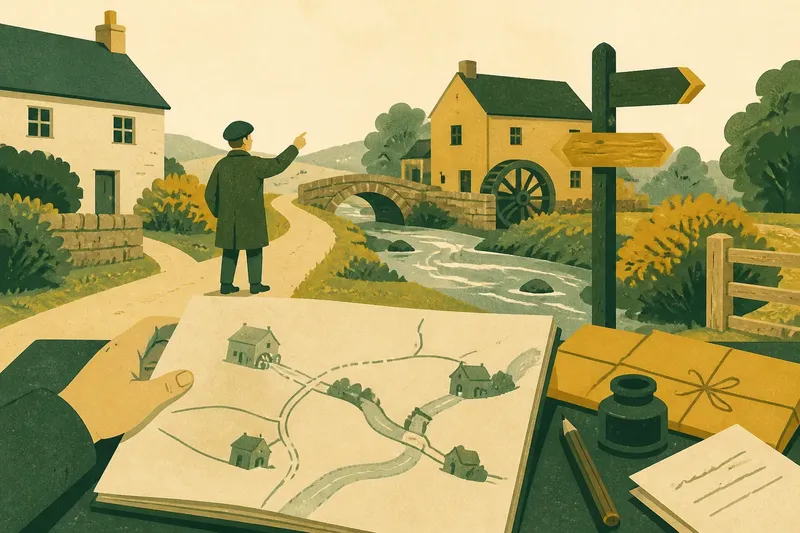
A neighbour sends you towards the mill, then says to turn where the lane meets the stream. Before street signs, place names made directions work by linking a destination to features people could recognise. The same name might guide a visitor, mark a building in a letter or label a wider area on a map.
How did place names guide someone without street signs?
People paired a destination with familiar reference points. They might name an inn, chapel, ferry landing or well, then describe the lane, crossing or path that led there. The name identified the goal; the route supplied the turns.
Directions could be tailored to the listener. A resident might understand “by the old well”, while a newcomer needed to know which road to take and what to look for along the way. A traveller could ask questions until a local reference matched something visible.
Think of a route as a spoken chain: start from a known place, follow a road or path, pass a recognisable feature, then reach the named destination. Each link helped the listener check that they were still going the right way.
Which place names helped people find their way?
Everyday names often came from work, buildings, natural features, people or a place’s position. A name could identify the destination itself or act as a waypoint.
- Work and trade: A mill, forge or market could name a place where people gathered to work or trade.
- Buildings and institutions: A church, inn, school or meeting hall offered a visible destination or landmark.
- Natural features: A ford, spring, hill, wood or bend in a stream could help distinguish one route from another.
- People and homes: A house or field might be known by the family or occupier associated with it.
- Position and connection: “Upper”, “lower” or “by the bridge” could distinguish a place or explain where it sat in relation to a route.
One name might do more than one job. A building’s name could also identify the lane beside it or the small neighbourhood around it. Its meaning depended on how speakers used it to direct one another.
Why did one place have several names?
People chose names to suit their purpose and audience. Residents might use a short local name, while a clerk wrote a fuller description in a ledger. A trader might refer to a place by its market; a visitor might identify it by a nearby church.
Names could also persist as buildings changed. A workshop might close while its name remained attached to the lane. A new school or public house could become a more useful landmark and gradually replace an older name in conversation.
Pay attention to the scale a speaker means. “The mill” could identify one building in a note about work, or the homes around it in directions. Other details in the sentence—such as a road, gate or neighbouring property—help show what area the name covers.
How did a spoken place name enter a record?
People wrote names in property descriptions, parish documents, business accounts, letters, directories, notices and maps. Each record served a different task. A property description might distinguish a plot; a directory might help someone find a business; a map needed a label that fitted its purpose and space.
A written form did not necessarily settle the name’s spelling or boundaries. A clerk could record what a name sounded like, or use the conventions of that document. A later copyist or map-maker might reproduce, alter or shorten it.
Read a name alongside the record around it. A map label may sit near a building, while a property entry may use the same words for the adjoining land. The descriptions, routes and boundaries nearby can clarify what the writer intended to identify.
How can you tell if a place name marks a destination or a landmark?
Notice the words around the name. An instruction to go “to” a place suggests a destination; a direction to turn “at” or pass “by” it suggests a landmark. The same site can serve both purposes, so read the whole sentence or record.
Imagine a family letter gives these directions: “Meet me at the bakehouse; take the lane from the bridge and stop at the door facing the stream.” A later map prints “Bakehouse” beside the lane junction. In the letter, the meeting point is the building’s door; on the map, the label helps locate the junction and the nearby building. The wording gives a definite answer: the name identifies the bakehouse, while its position also makes it a route marker.
When comparing records, note the physical clues each one gives: a door, lane, bridge, gate or adjoining building. That lets you distinguish a named destination from the point a traveller was meant to recognise on the way.
What questions help identify an old place name?
Does the name describe a feature or an activity?
A name may refer to a stream, slope or crossing, or to work such as milling or trading. Look for the feature or building nearby before taking the words as a literal description.
Who was expected to recognise the name?
A brief local account may assume that readers know the area, while a formal record may add a parish, owner or boundary. Consider the intended reader when deciding how much detail the name supplies.
Does the name point to one site or a wider area?
Compare how the name appears in different documents and note the roads, buildings and fields around it. If its apparent location varies, the name may have referred to a broader locality rather than one structure.
What changed around the named place?
Check for changes in a building’s use, ownership or surroundings, and for routes or landmarks that have moved or disappeared. A name may remain familiar after its original feature is gone.
How can place names make a route clear today?
Pair a local name with a visible feature and a clear direction. “Turn beside the library towards the river path” gives a listener something to recognise even if the local name is unfamiliar. If a map label and local speech differ, say which building, path or junction you mean.
For a useful note about a name, record the words a speaker uses, what they point to and whether they mean a building, corner or surrounding area. If you are tracing an older form, preserve the spelling used in each document rather than silently choosing one version. A local archivist can help interpret unfamiliar records.
Place names made directions possible by connecting words to recognisable features. When you hear an old name today, ask what a listener was expected to see next: a doorway, a crossing, a stream or the destination itself. That small distinction can turn a vague label into a route you can follow.